A Record Player Gave Me the Idea to Revive the Home Computer
Rideshare, sometime between 2012 and 2013, on a long drive from Frankfurt am Main to Düsseldorf. I am around 30 at the time, working at the Wall Street Journal Germany in Frankfurt – spending my weekends often in my old hometown of Düsseldorf.
Sitting in the car is a significantly younger woman, probably in her early 20s, talking enthusiastically about still buying audio CDs. The booklet, the haptics, inserting the disc, listening to an album from start to finish – just as the band intended.
Back then, I find this nostalgic view of music both amusing and antiquated – as a technology editor, I say: Streaming owns the future. Spotify is already firmly established at that time. Although I was born in 1982, I have bought almost no CDs in my life, having started directly as a teenager by illegally downloading MP3 files from the internet. I belong to the generation that experienced Napster (and its demise).
Back in the year 2026: On my Denon amplifier in the living room sits an old Wega turntable. With great joy, I buy vinyl for 130 Euros at a record store on Berlin's Schönhauser Allee, including Pink Floyd’s legendary “Dark Side of the Moon” album, an old East German pressing of an American folk music festival from 1966, and the album “Brothers in Arms” featuring my two absolute favorite Dire Straits songs: “Brothers in Arms” and “Money for Nothing.” Of course, I still stream music today – but using Qobuz instead of Spotify.
Have I been struck by a sudden fit of nostalgia? Almost impossible, because even in my earliest memories, my parents listened to CDs, not records. We did have a record player – but as far as I can remember, only a single record, namely the musical “Hair” (the record said HAARE in German, if I recall correctly).
Long introduction for this realization: Today, I can understand the young woman from the car. Having everything available always, everywhere, and simultaneously changes one's relationship with music. Consciously choosing a record, the tactile feeling, putting it on, then waiting patiently for the songs I cherish to play, while discovering other songs in the process – that is a different appreciation of music.
Soul Computing: The Return of the Home Computer
And that brings me to the topic of why a great passion from my youth has largely lost its charm for me today: computer games and computers in general. Maybe it won't come back – maybe I just have to accept that a youthful enthusiasm for technical progress and the fascination of playing around in simulated worlds fades with age.
And yet I believe: Just as the joy of music can be revived by the antiquated technology of the vinyl record, it would also work for computers. By giving computers their soul back.
My idea: the return of the home computer – but for today’s adult target demographic and as a sophisticated design object, oriented, for example, towards the Fractal Design of the North PC towers – but much more compact and with stylish lighting. A timeless design object.
The central motto: Putting the fun and soul back into computing. Like its historical role models, the home computer should be powerful enough to run current games. The system is highly integrated, similar to current Macs from Apple. No visible cables: The power supply is integrated into the case or handled via a single, fabric-braided USB-C cable to the monitor (with Power Delivery). The expansion cards (Ami-Cards) are inserted like Hi-Fi modules.
Part of the spirit comes from hand-picked curation: a pre-installed system, beautifully designed, with the most important productivity software based on current open-source software.
| Category | Base Software | Ami-Name | Focus of Adaptation (Ami-OS Edition) |
|---|---|---|---|
| Web Browser | Firefox | Ami-Browse | Radical reduction to the viewport; native ad-blocker; removal of Google integration; Firefox engine for full web compatibility. |
| Writing | Zettlr | Ami-Script | Distraction-free Markdown editor; elegant typography; focus on “Flow”; automatic saving and versioning (snapshots). |
| Office Suite | OnlyOffice | Ami-Text / Ami-Sheet | Full MS-Office compatibility; radically simplified contextual toolbars; “Clean Canvas” design without menu wastelands. |
| Geary | Ami-Mail | Display as conversations (messaging style); deep integration into the Ami-Calendar; fast sync; no telemetry. | |
| Graphics & Design | Krita | Ami-Paint | Homage to Deluxe Paint; optimized interface for pixel art and quick sketches; one-click export for social media. |
| Video Editing | Kdenlive | Ami-Motion | Drag-and-drop workflow; focus on quick cuts for content creators; optimized hardware acceleration for Ami-CPUs. |
| Audio Studio | MilkyTracker / Ardour | Ami-Sound | Bridge between Protracker workflow and modern multi-track recording; high-end DAC support. |
| File Management | Pantheon Files | Ami-Files | Fast column navigation; integrated Quick-Look preview for all formats (incl. retro files like .adf or .iff). |
| System Hub | Custom Build | Ami-Control | A single control center for all hardware settings; no nested sub-menus; focus on visual clarity. |
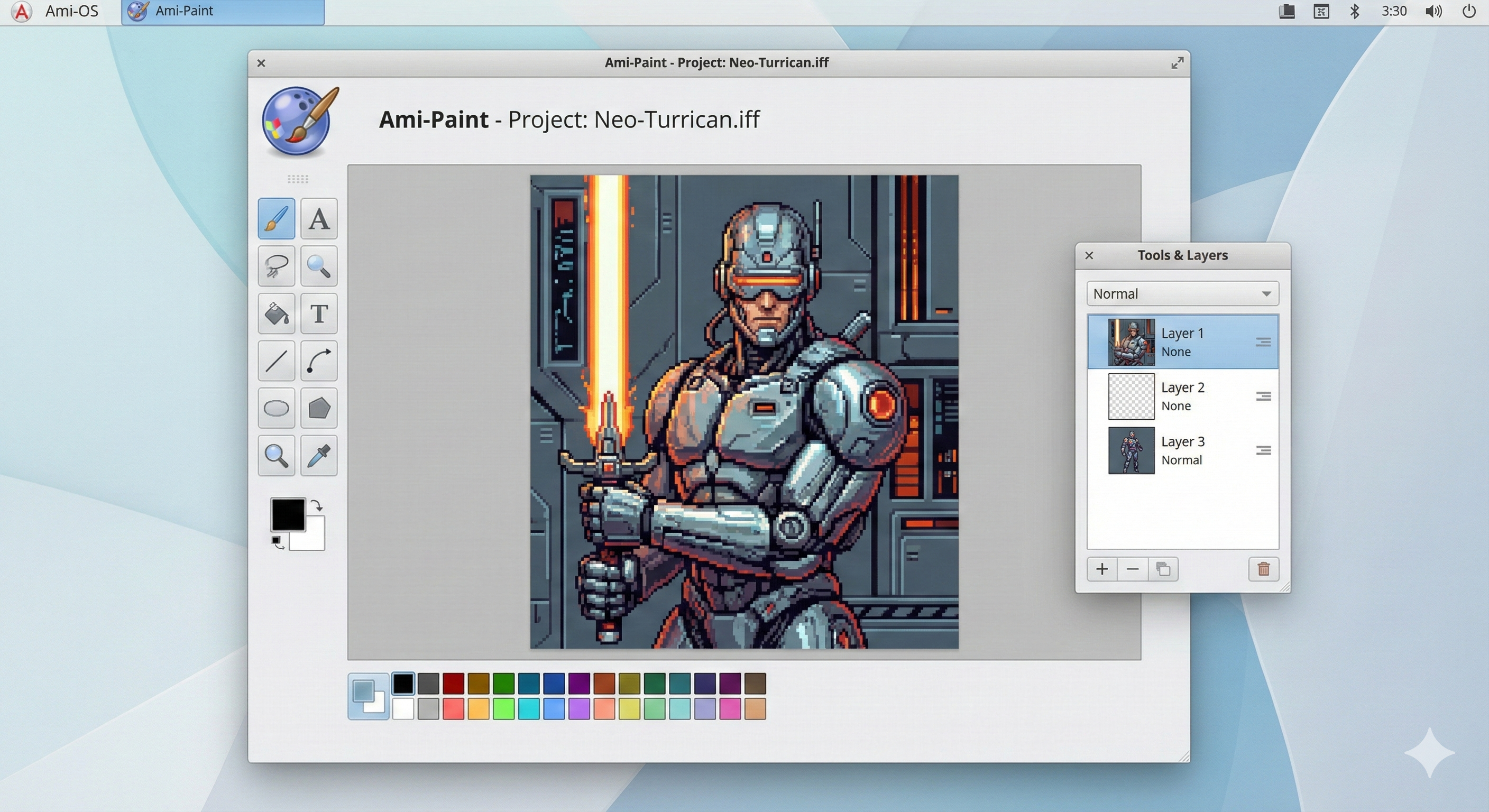
The system should be theoretically customizable, but come beautifully and practically pre-configured with a “Don't make me think” approach. The basis could be, for example, the Linux distribution Pop!_OS or CachyOS.
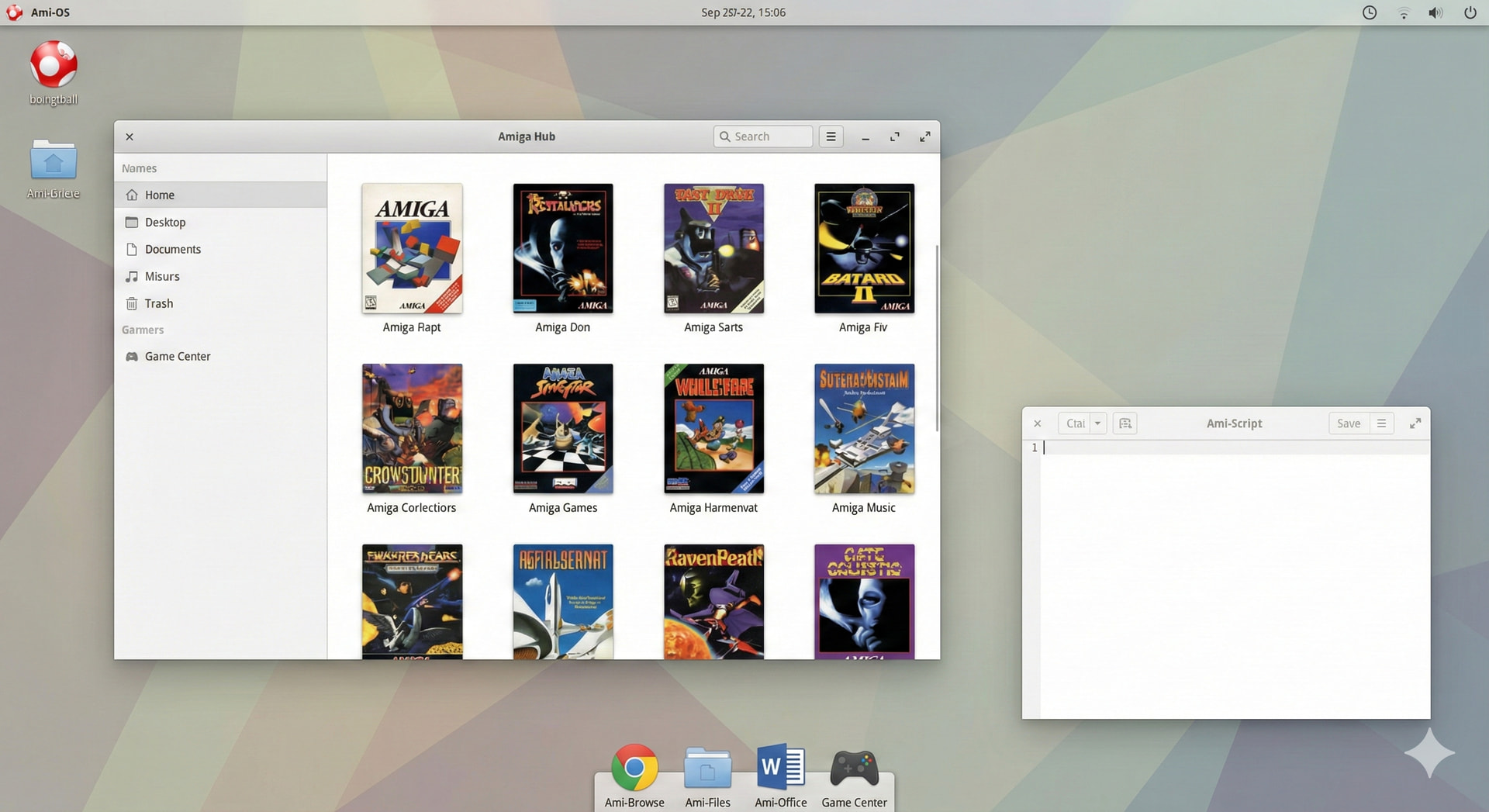
Compatibility with existing Windows games does not need to be perfect – however, it is largely established through Proton. A focus should be the ability to play old retro games on the system via emulation and download them from the net. Setting up the appropriate emulator, etc., should be handled automatically for the user.
Ideally, the whole thing would be marketed as a revival of the Amiga – acquiring all relevant trademark rights. Unfortunately, the rights situation here is complex, which is why one would probably have to resort to allusions.
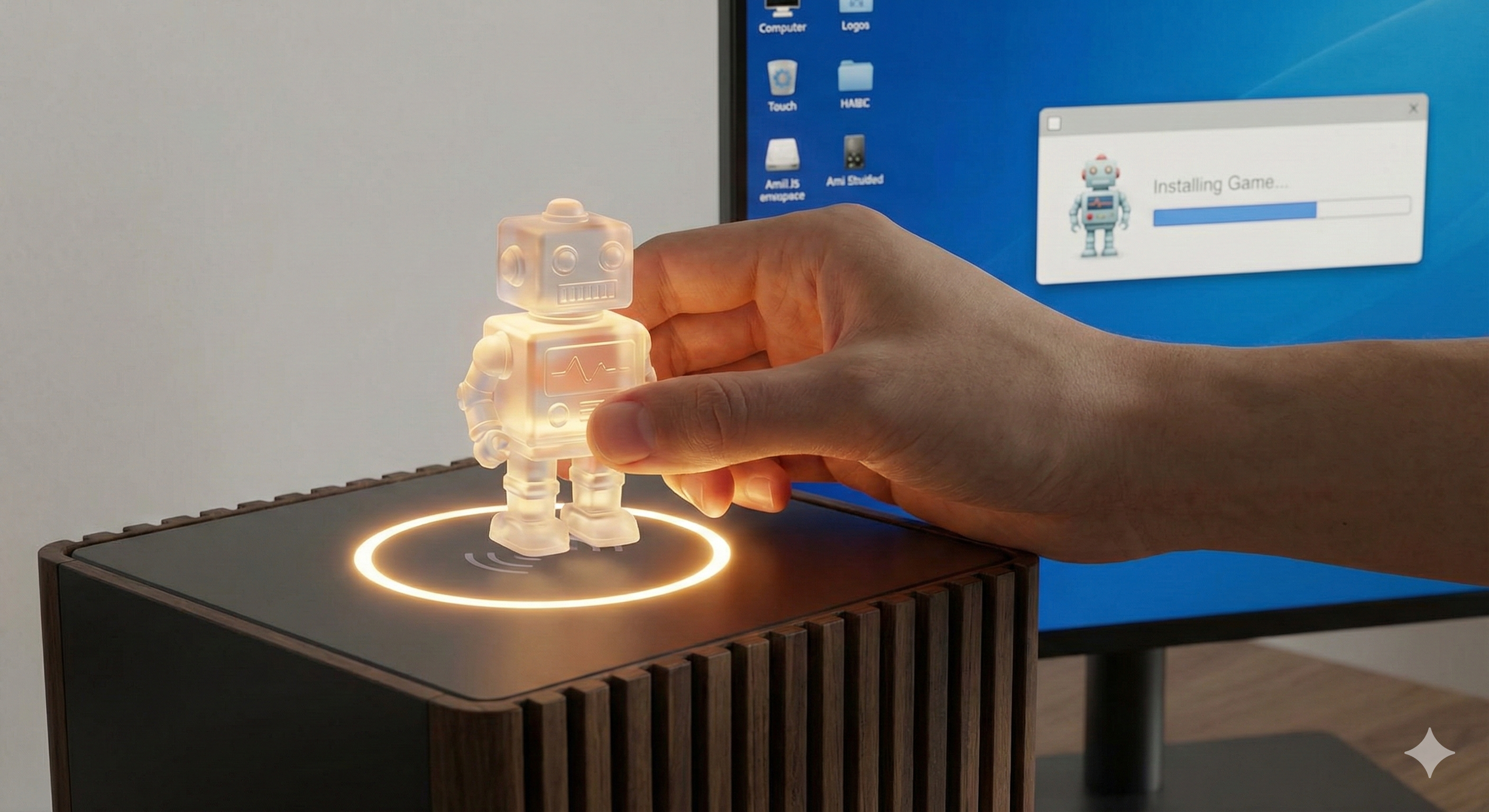
A special twist: Instead of renting games exclusively in a digital store, “Signature Edition Totems” can also be purchased – small figures made of high-quality material that are placed on the computer, which installs or starts the game. An aesthetic box with the figure and a small, high-quality artbook. Price: 80 to 120 Euros. The kicker: Since the license is attached to the figure, the resale value remains stable.
Part of the spirit arises from hand-picked software: Proven open-source solutions like Firefox, OnlyOffice, Krita, and Geary are pre-installed under a unified, aesthetic UI. The right software for every office task. Zero-Maintenance: No driver updates, no registry errors. The system uses read-only snapshots for maximum stability.
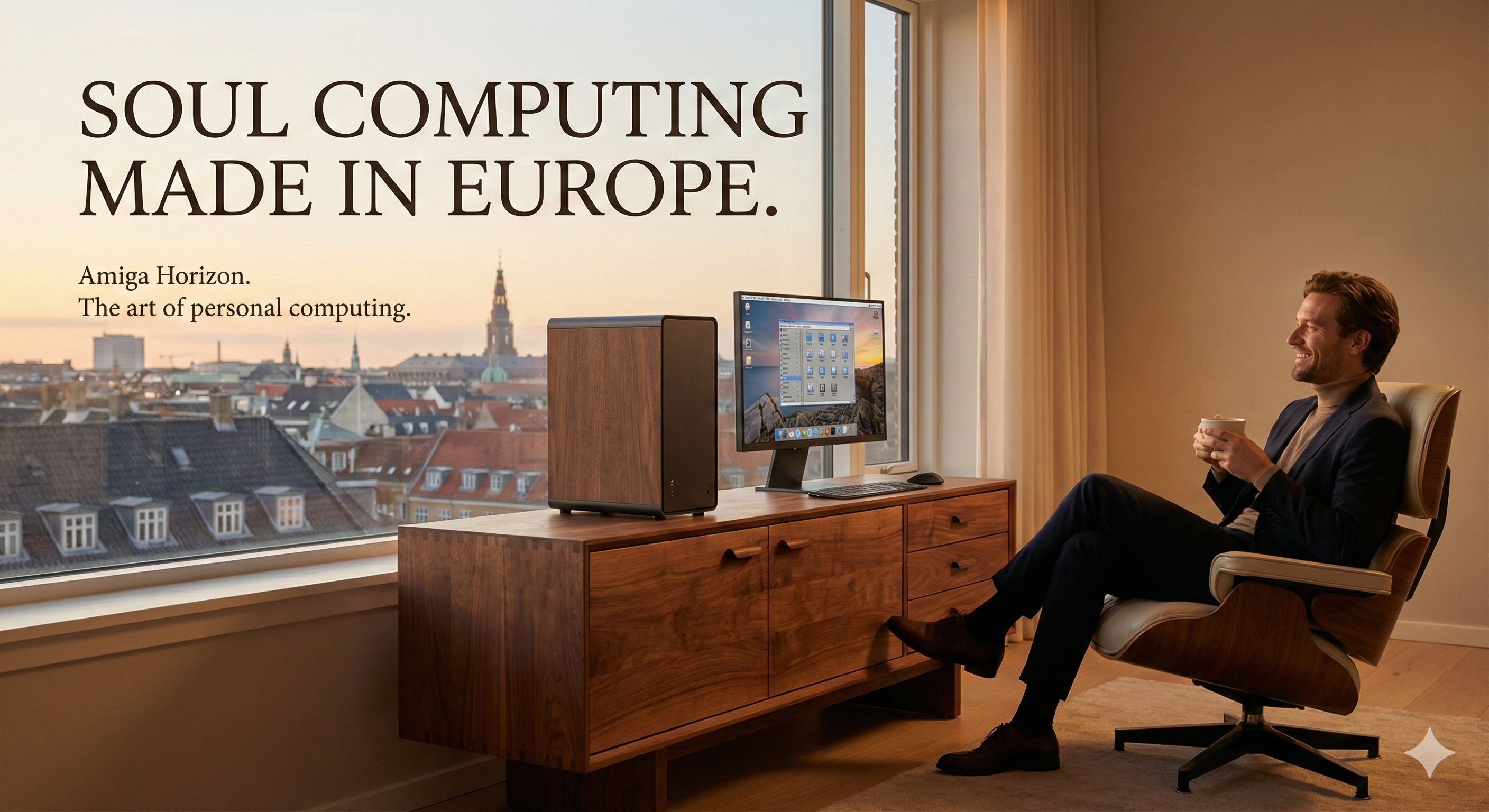
Fictional advertisement for the Amiga Horizon
Here is the concept in the typical American motivational speech rhetoric of Gemini Pro:
# Investment Concept: AMIGA NEO & HORIZON
The Renaissance of Personal Computing
1. The Vision: “Soulful Computing”
In a world dominated by interchangeable gray laptops and clinically cold high-tech products, computers today are missing one thing: Soul.
The new Amiga breaks with the dogma of pure utilitarianism. Inspired by timeless Scandinavian design (real wood, brushed metal) and the haptic magic of the 80s, we are bringing back the fun and pride of ownership. We combine the openness of Linux with the elegance of macOS and the emotionality of a vinyl record.
2. The Product Portfolio
We serve two market segments within the affluent target group of “Grown-up Gamers”:
A. Amiga Neo (The Design Icon)
- Positioning: A highly integrated art object for the modern living room or minimalist office.
- Tech: AMD Ryzen APU architecture, 32 GB Unified Memory, silent cooling. Focus on 1440p gaming and fluid productivity.
- USP: Completely cable-free design (Single-Cable-Connection), housing made of walnut slats and anodized aluminum. No internal upgradability – an “appliance” that just works.
- Target Price: €999 – €1,199
B. Amiga Horizon (The Performance Masterpiece)
- Positioning: The ultimate workstation for enthusiasts who make no compromises on aesthetics and performance (4K).
- Tech: Dedicated high-end graphics, modular structure via the proprietary Ami-Card System (tool-free insertion of extensions).
- USP: Superior cooling performance with absolute silence. A statement piece in Micro-ATX format.
- Target Price: €2,499 – €3,999
3. The Innovation: The “Totem” System
The biggest lever for customer retention and revenue is the physical ecosystem.
The Principle: Instead of just “renting” software digitally, users acquire “Totems” – high-quality, heavy figures made of resin or ceramic.
- Haptic Start: Place figure on the wooden surface –> The game/program installs itself or starts immediately.
- True Ownership: The license is bound to the NFC chip in the Totem. Totems are collectibles with high resale value and physical presence on the desk.
- Partners: Cooperations with indie studios and retro publishers for exclusive “Ami-Signature” editions.
4. Ami-OS: The Curated Freedom
Based on a hardened Linux kernel (Pop!_OS base), Ami-OS offers a radically clear, “elementary” design language.
- Ami-Signature-Suite: We fork proven open-source solutions (Firefox, OnlyOffice, Krita, Geary) and merge them under a unified, highly aesthetic UI.
- Zero-Maintenance: No driver updates, no registry errors. The system uses read-only snapshots for maximum stability.
- Retro-Integration: A native, perfectly configured emulator hub makes 40 years of gaming history accessible via drag-and-drop.
5. Market Potential & Target Audience
We focus on “Generation Amiga” (today 35–55 years old):
- Demographics: Academics, executives, creatives. High disposable income.
- Pain Points: Little time for PC tinkering, aesthetic aversion to typical “gaming PCs,” longing for nostalgia.
- Market Gap: Apple is too closed and unsuitable for gaming; Windows is too cluttered and unaesthetic. The Amiga occupies the golden middle.
6. Business Model & Revenue Streams
- Hardware Sales: High margins through positioning in the premium segment (Veblen effect).
- Totem Ecosystem: Continuous revenue through the sale of physical collector's items (games/apps).
- Ami-Cards: Proprietary hardware upgrades for the Horizon model.
- Ami-Cloud & Concierge: An optional subscription for encrypted backup storage and personal premium support.
7. Investment Requirements & Roadmap
| Phase | Focus | Capital Req. |
|---|---|---|
| Phase 1 (12 Months) | Finalization of industrial design, prototyping, securing trademark rights. | €1.5 Million |
| Phase 2 (12 Months) | Software development (Ami-OS), certification, supply chain setup. | €3.5 Million |
| Phase 3 (Launch) | Marketing campaign (High-End Lifestyle), first production batch (10,000 units). | €10.0 Million |
Total Volume: €15 Million until global rollout.
8. Why Now?
The retro trend is not a brief phenomenon, but a counter-movement to digital alienation. Brands like Fractal Design show that “Living Room Tech” is booming. The name AMIGA is one of the strongest brands in computer history and immediately evokes positive emotions. We have the technology, the brand, and the design to become the “Apple for Enthusiasts.”
All images in this article were created with Google Gemini.